Journal papers (peer reviewed) by Juan Gamero-Salinas
Scientific Reports, 2025
Improving thermal comfort often impacts daylight, creating trade-offs that remain underexplored, ... more Improving thermal comfort often impacts daylight, creating trade-offs that remain underexplored, particularly in tropical dwellings. Overheating metrics-essential for assessing thermal conditions in warm regions-are entirely absent from daylight performance analysis. Response Surface Methodology (RSM) and desirability functions were employed to optimize the thermal and daylight performance of a typical low-rise tropical housing typology. Specifically, this approach simultaneously optimized Indoor Overheating Hours (IOH) and Useful Daylight Illuminance (UDI) metrics through an Overall Desirability (D). Each response required only 138 simulation runs (~ 30 h: 276 runs) to determine optimal values for passive strategies: window-to-wall ratio (WWR) and roof overhang depth across four orientations (eight factors). Initial screening based on 2 8-2 V fractional factorial design, identified four key factors using stepwise and Lasso regression, narrowed down to three: roof overhang depth on the south and west, WWR on the west, and WWR on the south. Then, RSM optimization yielded an optimal solution (west/south roof overhang: 3.78 m, west WWR: 3.76%, south WWR: 29.3%) with a D of 0.625 (IOH: 8.33%, UDI: 79.67%). Finally, robustness analysis with 1,000 bootstrap replications provided 95% confidence intervals for the optimal values. This study balances thermal comfort and daylight with few experiments using a computationally-efficient multiobjective approach.

Energy and Buildings, 2022
The lack of green open spaces undermines the environmental and social quality of tropical highly-... more The lack of green open spaces undermines the environmental and social quality of tropical highly-dense cities (i.e. raises urban temperatures, limits social interaction). The goal of this study, which focused on environmental aspects, was to identify underlying factors (i.e. hypothetical constructs) in semi-outdoor spaces within building forms that explain their microclimatic behaviour, thermal comfort levels, and clustering. Sixty-three semi-outdoor spaces in four high/mid-rise building forms of Singapore were studied using microclimatic data collected from field measurements and analysed via inferential statistical methods (e.g., exploratory factor analysis, multivariate regression analysis, and hierarchical clustering analysis). Findings demonstrate: (1) that spatial attributes (i.e. height, depth, void, solid, total frontage, open frontage, area, volume, perimeter, sky view factor, green plot ratio) are manifestations of three underlying factors: volume porosity (VP), perimeter openness (PO) and exposure to sky (ES); (2) that VP and PO are significantly associated with air velocity and predicted thermal comfort; and (3) that vertical breezeways appear to be the most thermally comfortable cluster due to high VP and low PO. This study sheds new light on the spatial nature of semi-outdoor spaces, which designers can consider in order to enhance wind movement for promoting thermally comfortable semi-outdoor environments in highly-dense Singapore.

Energy and Buildings, 2021
Year-round high temperatures and humidity in the Tropics, coupled with poor design decisions and ... more Year-round high temperatures and humidity in the Tropics, coupled with poor design decisions and climate change, can cause indoor environments to overheat, affecting health and increasing energy demand and carbon emissions. Passive cooling could help lower the indoor overheating risk. Given the gap in the relative influence of passive cooling design strategies on lowering the indoor overheating risk in tropical locations, this study investigated their impact in two warm tropical cities (i.e., Tegucigalpa and San Pedro Sula), considering both current and future climate scenarios, with a total of 3840 thermal simulations performed. Indoor overheating risk in apartment-type dwellings was assessed using two metrics (i.e., hours of exceedance and the indoor overheating degree), and considering fixed and adaptive thermal comfort limits. Simulation results show that the overheating risk can be significantly lowered in these tropical contexts using solely passive cooling strategies as heat adaptation measures. Multivariate regression models demonstrate that natural ventilation, wall absorptance, the solar heat gain coefficient, and semi-outdoor spaces have the greatest impact in lowering the risk in vertical social housing projects. This study emphasizes the importance of passive cooling and overheating protection design strategies in tropical building codes and building design while considering current and future risk.

Building and Environment, 2021
In highly dense tropical cities, a semi-outdoor space (SOS) is frequently used as a social space ... more In highly dense tropical cities, a semi-outdoor space (SOS) is frequently used as a social space within tall building forms where people can interact and connect. Thermal comfort in SOSs within tall buildings, however, may vary depending on the type and form attributes that define it. This study classifies 63 SOSs in four tall buildings of Singapore into five types based on literature review: perimeter buffers, sky terraces, horizontal breezeways, breezeway atria and vertical breezeways. Findings suggest that the five SOS types perform differently in terms of thermal comfort (based on PMV*), environmental parameters (air temperature, mean radiant temperature, relative humidity, and air velocity), and building form attributes (height-to-depth ratio, open space ratio, and green plot ratio). Of these five, vertical breezeways and horizontal breezeways are the most thermally comfortable for all activities during a typically warm hour. It is postulated that higher thermal comfort levels in these SOS types are linked to form attributes that enhance air velocity. This study examines the pros and cons of each SOS type in terms of thermal comfort in their role as communal spaces in tall buildings situated within a highly dense tropical city. © 2021 The Authors
© 2021 This manuscript version is made available under the CC-BY-NC-ND 4.0 license https://creativecommons.org/licenses/by-nc-nd/4.0/

The influence of building form variables on the environmental performance of semi-outdoor spaces. A study in mid-rise and high-rise buildings of Singapore
Energy and Buildings, 2021
This study delved on the role of semi-outdoor spaces (SOS), as form-based strategies, in providin... more This study delved on the role of semi-outdoor spaces (SOS), as form-based strategies, in providing enhanced, thermally comfortable environments in highly dense urban contexts. A sample of sixty-three (63) SOS was studied, within four different mid-rise and high-rise buildings located in the warm-humid tropical city of Singapore. It was found: (i) that SOS may act as thermal buffer spaces; (ii) that microclimate creation in SOS is linked to form, specifically to geometrical variables such as void-to-solid ratio, height, height-to-depth ratio, height from ground level, green plot ratio and open space ratio, which influence significantly the environmental factors of air temperature, mean radiant temperature, air velocity and relative humidity; (iii) that some aforementioned geometrical variables (height-to-depth ratio and open space ratio) are linked to thermal comfort when estimated with SET* and PMV* thermal indices; (iv) and that thermal comfort (between −1 and +1 PMV*) can be achieved in SOS considering a typical Singaporean outdoor CLO of 0.3, especially for 1 MET (85.7% of SOS). In the context of Singapore, this study demonstrates that incorporating SOS to mid-rise and high-rise building forms promotes the creation of thermally comfortable microclimates suitable for human activity, even during the hottest hours. © 2020 Elsevier B.V.
Overheating risk assessment of different dwellings during the hottest season of a warm tropical climate
Building and Environment, 2020
Cities with hot tropical climate suffer generally from warm conditions during all year long, whic... more Cities with hot tropical climate suffer generally from warm conditions during all year long, which could result on buildings ‘overheating’ or high energy consumption by cooling. This paper is the first of its kind in Central America, region that lacks studies regarding thermal performance of buildings. This study develops an overheating risk assessment to twelve dwellings of Tegucigalpa, Honduras, with a warm tropical climate, based on 41-day field study measurements of indoor air temperatures during its hottest season of the year. The aim of the study was to find if overheating risk differed depending on the building typology, single-family (SD) or apartment-type (AT), and based on the latter, to what extent roof exposure to solar gains and material properties, such as u-values and thermal mass, are parameters that influence the risk of overheating. The adopted methodology followed CIBSE TM52 Overheating Risk Methodology, and EN15251 and ASHRAE 55 adaptive thermal comfort approaches. Overheating risk was found to vary depending on the residential building typology. Dwellings with high roof exposure and high u-values in roof were found to be ‘overheating’ more. Following CIBSE TM52 methodology, some AT and SD dwellings experienced hours of exceedance above 3% of occupied hours, reaching up to 12.5% (61 h) and 20.3% (133 h) of occupied hours, respectively. Passive strategies such as improving roof properties (e.g. low u-values), shading and night ventilation may be necessary to reduce the risk of overheating in Tegucigalpa and similar tropical contexts where air conditioning is less affordable. © 2020 Elsevier Ltd
Conference papers (peer reviewed) by Juan Gamero-Salinas
REHABEND 2020 - 8th Euro-American Congress: Construction Pathology, Rehabilitation Technology and Heritage Management , 2020
This study develops an assessment of indoor thermal comfort conditions in five apartment-type dwe... more This study develops an assessment of indoor thermal comfort conditions in five apartment-type dwellings of a rehabilitated building, previously abandoned, now intended for residential use, which is in the city of Tegucigalpa, Honduras, with a tropical hot climate. For the development of the study, a monitoring of indoor temperatures was developed for 41 days during the hottest and driest season of the year. Since this unprecedented pilot project seeks to promote new housing projects in the historic center of Tegucigalpa, the objective of this study was to measure whether the rehabilitation was effective in terms of thermal habitability conditions. The rehabilitation was assessed by identifying the hours of exceedance where indoor operative temperature exceeds the maximum acceptable temperature, following the adaptive thermal comfort approach of ASHRAE Standard 55. The study demonstrates that the preservation of passive measures of the original design (sun protection in the facade and the inner courtyard) help to provide comfortable indoor temperatures during the hottest period of the year, with the exception of some dwellings that experienced hours of exceedance during the afternoon and evening hours. Among the factors that influenced dwellings to experience hours of exceedances, is the lack of natural ventilation, orientation and level in the building. Rehabilitation projects can achieve the double objective of preserving the identity of the building and the city center, and in turn provide healthy thermal conditions for the occupants.
Citation:
Gamero-Salinas, J. C., Monge-Barrio, A. & Sánchez-Ostiz, A. (2020). A thermal comfort assessment in a rehabilitated residential building of the City Center of Tegucigalpa, Honduras. In: Lombillo, I., Blanco, H., & Boffill, Y. (Eds.), REHABEND 2020 - 8th Euro-American Congress: Construction Pathology, Rehabilitation Technology and Heritage Management (pp. 1849-1856). Spain, University of Cantabria – Building Technology R&D Group
Planning Post Carbon Cities. Proceedings of the 35th PLEA Conference on Passive and Low Energy Architecture, 2020
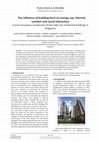
Two recently completed high-rise residential developments, located side-by-side in a neighbourhoo... more Two recently completed high-rise residential developments, located side-by-side in a neighbourhood in Singapore, are compared in a post-occupancy study. Both have near identical demographics, are exposed to the same microclimate, and constructed with a similar palette of materials. The primary difference is form. One has a high degree of porosity with inner voids that act as conduits for natural air flow and offer a sheltered space for social engagement. The other is more compact, less porous and has social spaces attached to the building's exterior. The study included surveys of residents, behavioural observations and environmental measurements. On three counts -self-reported energy use, thermal comfort and social interaction - the former appears to be more successful than the latter. Findings suggest that building form affects multiple outcomes at once. A form strategy that lowers energy use, for instance, can also improve social engagement. The implication of this socio-environmental approach to form-making is discussed in the context of high-density tropical typologies.
© Edition: University of A Coruña and Asoc. PLEA2020 Planning Post Carbon Cities
© Individual papers: the respective authors
How to cite:
Gamero-Salinas, J. C., Kishnani, N., Monge-Barrio, A., Gandhi, B., Bilgi, M. & Sánchez-Ostiz, A. (2020). The influence of building form on energy use, thermal comfort and social interaction. A post-occupancy comparison of two high-rise residential buildings in Singapore. In: Rodríguez Álvarez, J., & Soares Gonçalves, J.C. (Eds.), Planning Post Carbon Cities. Proceedings of the 35th PLEA Conference on Passive and Low Energy Architecture (Vol. 1, pp. 61-66). A Coruña: University of A Coruña. https://doi.org/10.17979/spudc.9788497497947
Preprints by Juan Gamero-Salinas
arXiv preprint, 2024
Response Surface Methodology (RSM) and desirability functions were employed in a case study to op... more Response Surface Methodology (RSM) and desirability functions were employed in a case study to optimize the thermal and daylight performance of a computational model of a tropical housing typology. Specifically, this approach simultaneously optimized Indoor Overheating Hours (IOH) and Useful Daylight Illuminance (UDI) metrics through an Overall Desirability (D). The lack of significant association between IOH and other annual daylight metrics enabled a focused optimization of IOH and UDI. Each response required only 138 simulation runs (~30 hours for 276 runs) to determine the optimal values for passive strategies: window-to-wall ratio (WWR) and roof overhang depth across four orientations, totalling eight factors. First, initial screening based on $2_V^{8-2}$ fractional factorial design, identified four key factors using stepwise and Lasso regression, narrowed down to three: roof overhang depth on the south and west, WWR on the west, and WWR on the south. Then, RSM optimization yielded an optimal solution (roof overhang: 3.78 meters, west WWR: 3.76%, south WWR: 29.3%) with a D of 0.625 (IOH: 8.33%, UDI: 79.67%). Finally, robustness analysis with 1,000 bootstrap replications provided 95% confidence intervals for the optimal values. This study optimally balances thermal comfort and daylight with few experiments using a computationally-efficient multi-objective approach.

SSRN Preprint, 2024
This study investigates indoor thermal comfort during heatwaves in dwellings of the Southern Euro... more This study investigates indoor thermal comfort during heatwaves in dwellings of the Southern European city of Pamplona, Spain. Utilizing K-means and Hierarchical clustering, it explores clustering patterns from occupants' survey responses (n = 189) to thermal comfort-related questions (i.e. day and night thermal sensation, thermal satisfaction and thermal preference) as well as causal links (i.e. indoor temperatures, building/occupant features) and consequences (i.e. sleep quality, heat-related symptoms) of such clusterings. Both unsupervised learning techniques coherently revealed two groups: the comfortable and uncomfortable clusters. Uncomfortable occupants coherently experience more sensation to heat, greater preference for cooler temperatures, and more thermal dissatisfaction, especially during daytime hours. Dwellings of comfortable occupants experience median indoor temperatures around 26ºC during both non-heatwave and heatwave periods; dwellings of uncomfortable occupants equal or above 27ºC. Discomfort or overheating—coherently expressed by the thermally uncomfortable cluster—is alleviated by multiple factors related to the presence of active cooling technologies in all rooms, use of passive and low-energy cooling measures (e,g. fans), and higher income; exacerbated by heatwave conditions, larger household sizes, and being a woman. As coherently expressed by the uncomfortable cluster heat worsens the sleep quality of occupants (3 to 6-fold) and increases the likelihood of occupants to experience heat-related symptoms (17 to 19-fold). This study is particularly important to policymakers, as it sheds light, from dwellers’ first-hand experience in a Southern Europe city, on relevant factors that should be taken in consideration to allow them to cope better with heatwaves without compromising their comfort and health. This preprint research paper has not been peer reviewed.



Uploads
Journal papers (peer reviewed) by Juan Gamero-Salinas
© 2021 This manuscript version is made available under the CC-BY-NC-ND 4.0 license https://creativecommons.org/licenses/by-nc-nd/4.0/
Conference papers (peer reviewed) by Juan Gamero-Salinas
Citation:
Gamero-Salinas, J. C., Monge-Barrio, A. & Sánchez-Ostiz, A. (2020). A thermal comfort assessment in a rehabilitated residential building of the City Center of Tegucigalpa, Honduras. In: Lombillo, I., Blanco, H., & Boffill, Y. (Eds.), REHABEND 2020 - 8th Euro-American Congress: Construction Pathology, Rehabilitation Technology and Heritage Management (pp. 1849-1856). Spain, University of Cantabria – Building Technology R&D Group
© Edition: University of A Coruña and Asoc. PLEA2020 Planning Post Carbon Cities
© Individual papers: the respective authors
How to cite:
Gamero-Salinas, J. C., Kishnani, N., Monge-Barrio, A., Gandhi, B., Bilgi, M. & Sánchez-Ostiz, A. (2020). The influence of building form on energy use, thermal comfort and social interaction. A post-occupancy comparison of two high-rise residential buildings in Singapore. In: Rodríguez Álvarez, J., & Soares Gonçalves, J.C. (Eds.), Planning Post Carbon Cities. Proceedings of the 35th PLEA Conference on Passive and Low Energy Architecture (Vol. 1, pp. 61-66). A Coruña: University of A Coruña. https://doi.org/10.17979/spudc.9788497497947
Preprints by Juan Gamero-Salinas